Like us Add circle Follow us
                              welcome to myculturebase

Category
  • Home
  • Gadgets
    • Sub-Menu 1
    • Sub-Menu 2
    • Sub-Menu 3
  • Humor
  • Internet
    • Sub-Menu 1
    • Sub-Menu 2
    • Sub-Menu 3
  • Social
  • Venture

08080088387

Garden city mubi, Adamawa state Nigeria

Get Update on our recent Gadgets & Tabs

  • Home
  • members only
  • Kilba people

Recent Comments

Saturday, August 13, 2016

American Indian Culture

MycultureBase   8/13/2016 04:43:00 PM

Oklahoma has been home to 67 American Indian tribes. Learn about these native cultures at Oklahoma's museums, heritage centers and events that help celebrate and maintain Oklahoma's unique Native American heritage. Share in the sacred traditions of Oklahoma's American Indian tribes by attending an authentic celebration or powwow. Feel the rhythm of powwow drums, become awed by amazingly detailed native regalia and be swept away by American Indian fancy or jingle-dress dancing.

In Oklahoma, there are many opportunities to immerse yourself in tribal history, songs, art and culture. Attend the Red Earth Festival, held each summer in Oklahoma City, to witness over 100 Indian tribes from across North America compete in a breathtaking, elite dance competition and exhibit works from today's most celebrated Native American artists. Explore the history of the Five Civilized Tribes who were relocated to Indian Territory, or discover the culture of the American Indian tribes whose headquarters are in Oklahoma.

Order our free guide to Oklahoma's Indian Country to discover the top American Indian attractions and learn about the state's tribes. Travel to Oklahoma to experience the richness of American Indian culture firsthand.

Thursday, August 11, 2016

by Andrew Dunn (Deputy Manager of NCF's Gashaka Project, 1992-2001, Nigerian Conservation Foundation)

MycultureBase   8/11/2016 10:26:00 AM
image

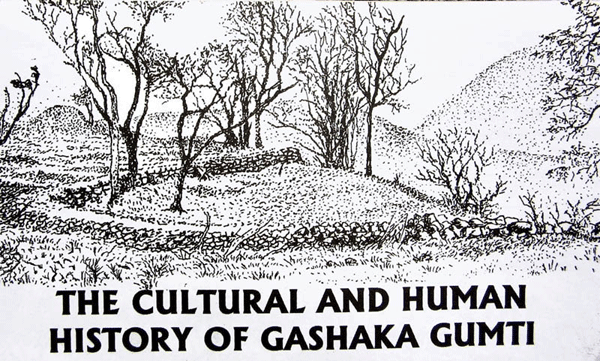
GASHAKA-GUMTI NATIONAL PARK (GANYE)

imageimageimageimageimageimage
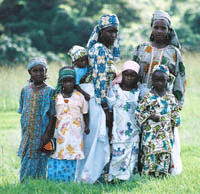
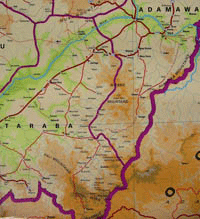
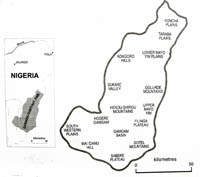
Gashaka-Gumti National Park is located in a mountainous region of North-east Nigeria adjacent to the international border with Cameroon, and immediately to the North of the Mambilla plateau. No roads cross this remote region and only a few lonely footpaths wind through the forested mountains towards Cameroon. Visitors to the park are able to enjoy lush forests, wide sweeping grasslands, cool highland plateaus, rugged moody mountains, abundant wildlife, and fascinating ethnic cultures, all combined within a single protected area.
There are few other places in the world that contain such spectacular scenery and such diverse wildlife. The hidden corner of west Africa that is Gashaka-Gumti National Park is surely one of the continent's best kept secrets.
Gashaka-Gumti National Park, the largest park in Nigeria, covers 6,731 sq km of wilderness. The park's name is derived from two of the region's oldest and most historic settlements: Gashaka village in Taraba State, and Gumti village in Adamawa State. Gashaka-Gumti National Park was created by Federal Decree in 1991 by the merging of Gashaka Game Reserve with Gumti Game Reserve. In this guidebook we will use the term Gashaka sector to indicate the Southern half of the park, and the term Gumti sector to indicate the Northern half.
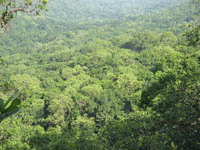
The Northern, Gumti sector of the park is relatively flat and covered with woodlands and grasslands, whilst the Southern, Gashaka sector is more mountainous and contains vast expanses of rainforest as well as areas of woodlands and montane grassland. This rugged terrain is characterised by steep, thickly forested slopes, deep plunging valleys, precipitous escarpments and swiftly flowing rivers. Altitude ranges from 450 metres above sea level in the wild savannah plains of the Northern sector, to the peaks and pinnacles of Gangirwal in the Southern park sector, which at a staggering 2,400 metres above sea level, represents Nigeria's highest mountain.
It is the sheer variety of different habitats within Gashaka-Gumti National Park that makes the area so uniquely rich in wildlife. In fact the park is actually an intricate mosaic of montane grasslands, savannah woodlands, swamps, lakes, mighty rivers, dark lowland rainforests, and luxuriant, montane rainforests strewn with ferns and orchids. Each habitat supports its own distinctive community of plants and animals.
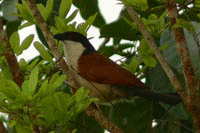
Rainforests provide a haven for animals such as the Giant forest hog, leopard, Yellow-backed duiker, Golden cat, and many different primate species including chimpanzees. Woodland savannahs are home to buffalo, lion, elephant, and Wild dog, as well as various antelopes such as waterbuck, Roan antelope, kob, hartebeest and the world's largest antelope, the Giant eland. The mountains of the park harbour populations of the rare Adamawa mountain reedbuck, in addition to Black-and-white colobus monkey, baboon, warthog, oribi, and klipspringer. Whilst its largest unspoilt rivers contain hippos, crocodiles, otters and a wide variety of fishes. The park is officially labelled as one of Africa's "Important Bird Areas" - and with more than 500 species found here, this is certainly no exaggeration. Visiting bird watchers constantly add new species to the list. An additional abundance of creatures such as butterflies, flowers and trees, makes this park a naturalists' paradise, unrivalled anywhere for diversity.

Wednesday, August 10, 2016

History Of the Great Chamba people of Nigeria (sama) Capital at Ganye

MycultureBase   8/10/2016 06:07:00 PM


Image result for history of chamba tribe in nigeria     Image result for history of chamba tribe in nigeria           Image result for history of chamba tribe in nigeria

The Chamba (Sama) people of Ganye Chiefdom make up one of the largest single ethnic groups in the North eastern Nigeria and are no doubt the most populous single ethnic group in Adamawa south if not the entire Adamawa state.
Today the Chamba people are spread across five local government areas of Adamawa State, namely: Jada, Ganye, Toungo, Mayo-Belwa, Yola and Fufure Local Government Areas respectively and Gashaka, Sarti Bali, and Takum in Taraba State also into the Cameroon republic. They predominantly occupy Jada, Ganye and Toungo Local Government areas in Adamawa State. Being Agrarians by culture, they live in a very fertile agro-zone that spreads to the Cameroon borders.
Chambaland is a mixture of heath savannah and semi rain forest with undulating hills and prestigiously extended landscapes that host till today great wildlife that is depicting the beauty of the flora and fauna. The chambaland enjoys the highest amount of rainfall in the whole of Adamawa state. The land is the home of major food productions in the country.
This area was never part of Nigeria legally until the February 1961 plebiscite where it was decided by vote the position of the people of the then northern Cameroon which was entrusted to the colonial Britain as a Trust Territory by the United Nations following the defeat of Germany in the Second World War. This was ratified in the trusteeship agreement entered into by the United Kingdom for the territory of the Cameroon, previously administered by it under the League of Nations after the defeat of Germany in 1916 (WWI). The Anglo-French agreement of March 4, 1916 divided Cameroon into two to be control by two separate powers. Later in 1922 by an instrument signed in London on July 22nd, France was given a mandate under the League of Nations to be in charge of the administration of the territory of the Cameroon but the western potion was mandated to the British. This is the same mandate regime that lasted till the coming into force of trusteeship agreement which was ratified by the General Assembly of United Nations on 13th December, 1946. That is to say that the area that is called Ganye chiefdom today was not colonised by the British.
The area was a German colony. But when Germany went to war in 1914- 1918 and was defeated, the League of Nations took over the area from Germany and subsequently when Germany suffered defeat again in the World War II (1939 -1945) The United Nations mandated the region belonging to Germany to Britain and France.
This article may not be so involved with the historical details of what transpired over time but it will not be out of place for the writer to carry the readers along by bearing light on some important details. The principle lay down by the charter of United Nations for the administration of the Trustee territories give formal dedication to respect for the personality of the territories. Article 76 of the charter spells it out as such: “to promote the progressive development of the inhabitants of the trust territories towards self-government or independence as may be appropriate to the particular circumstances of each territory and its people and the freely expressed wishes of the people concerned, and as may be provided by the terms of each trusteeship agreement.”
Nothing was said about this until 1959 when Nigeria which was yet a colonial property of the British though on the verge of Independence; the issue was raised as to where the chambaland (Chamba Native Authority) and the entire trustee territory of the northern Cameroon (from the Mambila Hills in Taraba to Bama in Borno) will belong. That led to a referendum that Nigeria and her cohorts rejected the result. In the result all the places concern voted for being in the Cameron. In the November 7th 1959 plebiscite the electorates rejected being in Nigeria by 70,401 “Noes” against 42,797 “Yes” for the proposed integration with Nigeria. In about a year later that verdict was said have been reversed by the same people. This was what called for concern. This was supposed to be the true reflection of the interest of the majority and it was supposed to be respected by both the international community and Nigeria, but it was cancelled.
Nothing was said again until a yearlong after independence. Those areas where unwillingly pulled along into the affairs of an independent Nigeria; though UN general Assembly clearly recommended “that the necessary steps be taken without delay to secure a wider decentralisation of administrative powers and an effective democratization of the local administrative system in the northern portion of the trust territory” it was also recommended “that the administering authority shall take immediate steps for the administrative separation of North Cameroon and Nigeria, such separation to take effect from 1st October, 1960.”
The Premier of the Northern Nigeria Sir Ahmadu Bello Sadauna of Sokoto led a vigorous campaign to ensure that the Trust Territory was pulled into the Nigerian territories legally. He navigated into the thick forests of Chambaland and under the then Northern government, he provided incentives such as a Hospital to Ganye (the Headquarters of Chamba Native Authority) a tool for campaigning for their vote in favour of Nigeria (The Land will remain grateful for that development.) So much was promised to the Chamba people including their being recognised and treated with dignity.
When the plebiscite of February 1961 was counted it purported that the vote was in favour of Nigeria. But one thing was outstanding: All other Natives authorities and districts voted in favour of Nigeria except Chamba Native Authority. Although that made no difference at all since they were never let to go to the Cameroon.
The matter went to court and some Chamba elites where persecuted for that; they were incarcerated in prison for a period of time treating them like rebels just to get them keep quiet about what they believed was a clear injustice to them. There was no unambiguous end to the litigation on the matter of whether the chambaland was Nigeria or Cameroon or an Independent State.
Now these people (Chamba people) have been pulled along, what is the benefit of being in Nigeria? Would they have been better off if they were in the Cameroon? Only God knows that. But one thing is clear; the chambaland is not in a good shape. The land and the people have suffered neglect and have been undermined by some socio-political apparatus set in place by some people who ordinarily would have no business doing that if the chambaland was not part of Nigeria.
Peace loving and accommodating people, Chamba people have kept good relationship with their close neighbours like the Mumuye. The Fulani who also have enjoyed this humane relationship of the Chamba, moved into the area long time ago and they have interrelated for many decades. In fact the presence of Islamic religion in Chambaland can be attributed to the coming of the Fulani among them since there was no Jihad in the land. Today in most the of the towns and villages of chambaland there are the Igbos, Hausa People, Tivs and other distant tribes apart from the Mumuye and the Fulani. The chamba people do not have a history of bigotry, intolerance or segregation. They have accommodated the strangers in their midst with love and have even inter-married with many.
With the wake of the recent physical and psychological attacks on the Chamba, it clearly shows that the Chamba is getting hit below the belt. This of course calls for concern, on the one hand for the Chamba people to be more united among themselves irrespective religion or class difference so that they will be able to face their fate as a people and on the other hand it calls for proactive intellectual engagement for emancipation and protection of the land and people from both intellectual bondage and captivity of mentality.
One of the worst things that have happen to Chamba land in history is the recent attack on Ganye which left over a dozen innocent people dead which also resulted to lost property worth hundreds of millions and some other previous experiences like the robbery attack at the Ganye international Cattle Market where millions were taken away. Today it is clear that the trauma of these episodes is lingering in the minds of people in the entire Chamba land.
The chambaland has one of the worst roads in Nigeria. From Yola to Ganye which is supposed to be less than two hours now takes over four hours due to bad road. The government of Nigeria that dragged the Chambaland into it has not said anything for years.
With all these things happening one is left to ask if being in Nigeria was a curse. No one will explain what the Chamba land have done to these gun men that came except for the fact that it is a common thing in north eastern Nigeria.
The government should rise up to its responsibility of protecting lives and property of the people, the Chamba land is a border territory there is need for a stationed either mobile police barracks or military barracks for prompt response in case of any kind of attack. Since the land had become part of Nigeria with such peculiar antecedence, there is need for the people to see the importance of being in Nigeria.
The copious natural resources in this area if properly harnessed can yield great benefit to Nigeria. Since Nigeria has taken over the area for 52 years there is hardly any special attention to the region. It agreed that in whole Adamawa Chamba is most agro-supportive region why wont the government through it numerous agricultural projects site one important project there to touch the lives of these people. Those Chamba that migrated into the Cameron that time because of the result of the referendum are faring well. Let Nigeria not be curse.

Kilba Hong LGA Adamawa state Nigeria

MycultureBase   8/10/2016 05:51:00 PM
Kilba Hong LGA Adamawa state Nigeria Music traditional Dance video


Tuesday, August 9, 2016

The Warriors of AniKituhwa

MycultureBase   8/09/2016 04:11:00 AM


This dance group brings to life the Cherokee War Dance and Eagle Tail Dance as described by Lt. Henry Timberlake in 1762. They are designated as official cultural ambassadors by the Tribal Council of the Eastern Band of Cherokee Indians and are sponsored by the Museum of the Cherokee Indian. They have performed at Colonial Williamsburg, the National Museum of the American Indian, the Smithsonian Museum of Natural History, Montreal, and throughout the Southeast.  See some of their dances here. 
The War Dance was used not only when men went to war, but also when meeting with other nations for diplomacy and peace, and within the Cherokee nation was also used to raise money for people in need. It conveys the strength of the Cherokee nation.
The Warriors of AniKituhwa also perform Cherokee social dances, including the Bear Dance, Beaver Hunting Dance, and Friendship Dance. They talk about the significance of the dances, their clothing, and Cherokee history and culture. They can provide living history demonstrations and programs in flute, storytelling, Cherokee language, beadwork, quillwork, and more.
For more information, or to book them for an event, contact Barbara Duncan atbduncan@cherokeemuseum.org

SCHEDULE 2015

March 26,27,28 – Southeastern Festival Poarch Creeks, Atmore AL
May 10 – Lake Eden Arts Festival Performance, Black Mountain NC
May 11 – Lake Eden Arts Festival Informance, at Orange Peel, Asheville NC
June 6-7 – “Return of the Cherokees”, Colonial Williamsburg VA
June 13 – Cherokee Voices Festival, Museum of the Cherokee Indian
Sept 12-13 – National Folk Festival, Greensboro NC
Oct 6 – Cherokee Fall Fair, Cherokee NC
Nov 21 – American Indian Heritage Celebration, Raleigh NC
**********************************************************
Warriors of AniKituhwa on Facebook
**********************************************************

UPDATE–TEN YEARS!

Over the past ten years, the Warriors of AniKituhwa have inspired Cherokee people and the public with their image of strength and pride, bringing back dances from the 1700s, when Cherokees were a world power, making treaties with England, France, Spain, South Carolina, and Virginia. They broke the old stereotypes of Trail of Tears and Plains feather warbonnets, and provided a new image for Cherokee people.
They first performed for the Inter-Tribal Timber Council which met in Cherokee in 2003. In December 2004, they danced on the Palace Green in Colonial Williamsburg, where the last Cherokee delegation had danced in 1777.  Since then they have danced, participated in historical dramas, and presented living history at Colonial Williamsburg every year.  In February 2005, the Tribal Council of the Eastern Band of Cherokee Indians recognized them as cultural ambassadors with the Museum of the Cherokee Indian as their sponsor.
Since then, they have performed for Cherokee students here and in Oklahoma. Their clothing has inspired the Miss Cherokee pageant to adopt Cherokee clothing of the 1700s, and they have helped revive old clothing styles at the Oconluftee Indian Village and Unto These Hills outdoor drama. They have inspired other dance groups to bring back the dances of their grandfathers and grandmothers. Their faces became the “new face” of advertising for Cherokee as a destination, bringing visitors who were looking for an authentic Cherokee experience.
The Warriors of AniKituhwa have given more than 250 performances, for more than 300,000 people, and they have traveled thousands of miles. In addition to performances in Cherokee for the Cherokee Central Schools, Fall Fair, Kituhwa Celebration, and Red Clay Reunion, they have taken Cherokee culture to nine states, Washington DC, and Montreal Canada. They have been welcomed at the National Museum of the American Indian, and the Smithsonian Museum of Natural History in Washington DC. They have performed for cultural events for other tribes, including the Seminoles, Creek Nation, and the Poarch Creek Band. They have been an important part of Cherokee historical events, including the 2009 Red Clay Reunion, the 2010 Cherokee Victory Celebration at Fort Loudoun in Tennessee and the 2012 celebration of Emissaries of Peace, with seven events in four states. They have danced for meetings of the United South and Eastern Tribes and the National Congress of American Indians. Their ten year partnership with Colonial Williamsburg has led to the establishment of a full-time Cherokee person there, with Cherokee programs every week. This fulfilled a long-time goal of the American Indian Initiative at Williamsburg.
“I’m proud of our young men who have taken the initiative to dance traditional Cherokee dances. It’s assurance that our people will keep dancing and keep alive our authentic dances,” said Marie Junaluska, Tribal Council member from Painttown and one of the founders of the group.

AWARDS:

Mountain Heritage Award 2007
Best of the Mountains 2006

WARRIORS OF ANIKITUHWA SELECTED APPEARANCES:

  • National Museum of the American Indian, Washington DC
  • Smithsonian Museum of Natural History, Washington DC
  • Colonial Williamsburg, Williamsburg VA
  • National Folk Festival, Greensboro NC
  • American Indian Heritage Celebration, Raleigh NC
  • Cherokee Fall Fair, Cherokee NC
  • Cherokee Voices Festival, Cherokee NC
  • Kituhwa Celebration, Cherokee NC
  • Harrah’s Cherokee Casino, Cherokee NC
  • Red Clay Reunion, Red Clay TN
  • Cherokee National Holiday, Tahlequah OK
  • Mountain Heritage Day, Western Carolina University
  • Southeast Tribes Festival, Cherokee NC,  Atmore AL
  • Native American Festival, Moundville Archaeological Park AL
  • Sequoyah Birthplace Museum Festival, Vonore TN
  • University of Tennessee, Knoxville TN
  • First Nations Festival, Montreal Canada
  • University of North Carolina at Asheville NC
  • Charles George Veterans Hospital, Oteen NC
  • Stone Mountain Park, Stone Mountain GA
  • Decatur Book Fair, Decatur GA
  • Rabun Gap Nacoochee School, Dillard GA
  • Irish-Cherokee Cultural Exchange
  • Fulbright Scholars Cherokee Experience
  • North Carolina Humanities Council Cherokee Seminar
  • Cherokee Visitor Appreciation Day
  • Cherokee Preservation Foundation Community Event
  • Kituhwa Mound Annual Celebration
  • Maggie Valley Civil War Reenactment
  • Cherokee Fourth of July Powwow
  • Huber Corporation Documentary Film
  • Harrah’s Grand Opening of the Soco Tower
  • Bele Chere, Asheville
  • Stone Mountain Park
  • Sequoyah Birthplace Museum Festival
  • National Museum of the American Indian-First Anniversary Celebration
  • Festival of Native Peoples, Cherokee
  • Mountain Heritage Day at Western Carolina University
  • Cherokee Fall Fair
  • Colonial Williamsburg–historical reenactment and dance
  • SAMAB Conference, Cherokee
  • Warren Wilson College
  • North Carolina State
  • First Army, Atlanta
  • Cherokee High School Football games
  • Opening of Emissaries of Peace: the 1762 Cherokee/British Delegations

COMMUNITY OUTREACH

  • Dance workshops for the community
  • Pucker Toe Moccasin Making workshop
  • Performances for Cherokee Central Schools
  • Appearance at CHS football games

RESEARCH

  • Eastern Frontiers Conference, Akron, Ohio
  • University of Pennsylvania Museum of Archaeology
  • National Museum of the American Indian
  • Cherokee Language Immersion Class

FILM

  • Blue Ridge Parkway video
  • Huber Corporation
  • Emissaries of Peace exhibit video
  • Agee Films documentary on the Appalachians for PBS
  • Rabun Gap Nacoochee School promotional video
For additional information, email Barbara Duncan at  bduncan@cherokeemuseum.org

   
  •  
  •  
  •  
  • KILBA FOOD

    MycultureBase   8/09/2016 12:17:00 AM
    Image result for kilba cultural festival

    Sunday, August 7, 2016

    Historic regions: 5th century BC - 20th century

    MycultureBase   8/07/2016 07:33:00 AM


    Nigeria contains more historic cultures and empires than any other other nation in Africa. They date back as far as the 5th century BC, when communities living around the southern slopes of the Jos plateau make wonderfully expressive terracotta figures - in a tradition known now as the Nok culture, from the Nigerian village where these sculptures are first unearthed. The Nok people are neolithic tribes who have recently acquired the iron technologyspreading southwards through Africa.

    The Jos plateau is in the centre of Nigeria, but the first extensive kingdoms of the region - more than a millennium after the Nok people - are in the north and northeast, deriving their wealth from trade north through the Sahara and east into the Sudan. 


    During the 9th centurya trading empire grows up around Lake Chad. Its original centre is east of the lake, in the Kanem region, but it soon extends to Bornu on the western side. In the 11th century the ruler of Kanem-Bornu converts to Islam.

    West of Bornu, along the northern frontier of Nigeria, is the land of the Hausa people. Well placed to control trade with the forest regions to the south, the Hausa develop a number of small but stable kingdoms, each ruled from a strong walled city. They are often threatened by larger neighbours (Mali and Gao to the west, Bornu to the east). But the Hausa traders benefit also from being on the route between these empires. By the 14th century they too are Muslim. 


    In the savanna grasslands and the forest regions west of the Niger, between the Hausa kingdoms and the coast, the Yoruba people are the dominant tribes. Here they establish two powerful states.

    The first is Ife, on the border between forest and savanna. Famous now for its sculpture, Ife flourishes from the 11th to 15th century. In the 16th century a larger Yoruba empire develops, based slightly further from the forest at Oyo. Using the profits of trade to develop a forceful cavalry, Oyo grows in strength during the 16th century. By the end of the 18th century the rulers of Oyo are controlling a region from the Niger to the west of Dahomey. 


    Meanwhile, firmly within the forest, the best known of all the Nigerian kingdoms establishes itself in the 15th century (from small beginnings in the 13th). Benin becomes a name internationally known for its cast-metal sculpture, in a tradition inherited from the Ife (see Sculpture of Ife and Benin).

    In terms of extent Benin is no match for Oyo, its contemporary to the north. In the 15th century the region brought under central control is a mere seventy-miles across (people and places being harder to subdue in the tropical forest than on the savanna), though a century later Benin stretches from the Niger delta in the east to Lagos in the west. 


    But Benin's fame is based on factors other than power. This is the coastal kingdom which the Portuguese discover when they reach the mouth of the Niger in the 1470s, bringing back to Europe the first news of superb African artefacts and of the ceremonial splendour of Benin's oba or king.

    The kings of Benin are a story in themselves. In the 19th century they scandalize the west by their use of human sacrifice in court rituals. And they have stamina. At the end of the 20th century the original dynasty is still in place, though without political power. All in all, among Nigeria's many historic kingdoms, Benin has earned its widespread renown. 


    The Fulani and Sokoto: 1804-1903
    Living among the Hausa in the northern regions of Nigeria are a tribe, the Fulani, whose leaders in the early 19th century become passionate advocates of strict Islam. From 1804 sheikh Usman dan Fodio and his two sons lead the Fulani in an immensely successful holy war against the lax Muslim rulers of the Hausa kingdoms.

    The result is the establishment in 1809 of a Fulani capital at Sokoto, from which the centre and north of Nigeria is effectively ruled for the rest of the 19th century. But during this same period there has been steady encroachment on the region by British interests. 


    British explorers: 1806-1830
    From the death of Mungo Park near Bussa in 1806 to the end of the century, there is continuing interest in Nigeria on the part of British explorers, anti-slavery activists, missionaries and traders.

    In 1821 the British government sponsors an expedition south through the Sahara to reach the kingdom of Bornu. Its members become the first Europeans to reach Lake Chad, in 1823. One of the group, Hugh Clapperton, explores further west through Kano and the Hausa territory to reach Sokoto. Clapperton is only back in England for a few months, in 1825, before he sets off again for the Nigerian coast at Lagos. 


    On this expedition, with his servant Richard Lander, he travels on trade routes north from the coast to Kano and then west again to Sokoto. Here Clapperton dies. But Lander makes his way back to London, where he is commissioned by the government to explore the lower reaches of the Niger.

    Accompanied in 1830 by his brother John, Lander makes his way north from the coast near Lagos to reach the great river at Bussa - the furthest point of Mungo Park's journey downstream. With considerable difficulty the brothers make a canoe trip downstream, among hostile Ibo tribesmen, to reach the sea at the Niger delta. This region has long been familiar to European traders, but its link to the interior is now charted. All seems set for serious trade. 


    SS Alburkah: 1832-1834
    After Lander's second return to England a company is formed by a group of Liverpool merchants, including Macgregor Laird, to trade on the lower Niger. Laird is also a pioneer in the shipping industry. For the present purpose, an expedition to the Niger, he designs an iron paddle-steamer, the 55-ton Alburkah.

    Laird himself leads the expedition, with Richard Lander as his expert guide. 


    The Alburkah steams south from Milford Haven in July 1832 with forty-eight on board. She reaches the mouth of the Niger three months later, entering history as the first ocean-going iron ship.

    After making her way up one of the many streams of the Niger delta, the Alburkah progresses upstream on the main river as far as Lokoja, the junction with the Benue. The expedition demonstrates that the Niger offers a highway into the continent for ocean vessels. And the performance of the iron steamer is a triumph. But medicine is not yet as far advanced as technology. When the Alburkah returns to Liverpool, in 1834, only nine of the original crew of forty-eight are alive. They include a much weakened Macgregor Laird. 


    Trade and anti-slavery: 1841-1900
    The next British expedition to the Niger is almost equally disastrous in terms of loss of life. Four ships under naval command are sent out in 1841, with instructions to steam up the Niger and make treaties with local kings to prevent the slave trade. The enterprise is abandoned when 48 of the 145 Europeans in the crews die of fever.

    Malaria is the cause of the trouble, but major progress is made when a doctor, William Baikie, leads an expedition up the Niger in 1854. He administers quinine to his men and suffers no loss of life. Extracted from the bark of the cinchona tree, quinine has long been used in medicine. But its proven efficacy against malaria is a turning point in the European penetration of Africa. 


    The British anti-slavery policy in the region involves boosting the trade in palm oil (a valuable product which gives the name Oil Rivers to the Niger delta) to replace the dependence on income from the slave trade. It transpires later that this is somewhat counter-productive, causing the upriver chieftains to acquire more slaves to meet the increased demand for palm oil. But it is nevertheless the philanthropic principle behind much of the effort to set up trading stations.

    At the same time the British navy patrols the coast to liberate captives from slave ships of other nations and to settle them atFreetown in Sierra Leone. 


    From 1849 the British government accepts a more direct involvement. A consul, based in Fernando Po, is appointed to take responsibility for the Bights of Biafra and Benin. He undertakes direct negotiations with the king of Lagos, the principal port from which slaves are shipped. When these break down, in 1851, Lagos is attacked and captured by a British force.

    Another member of the Lagos royal family is placed on the throne, after guaranteeing to put an end to the slave trade and to human sacrifice (a feature of this region). When he and his successor fail to fulfil these terms, Lagos is annexed in 1861 as a British colony. 


    During the remainder of the century the consolidation of British trade and British political control goes hand in hand. In 1879 George Goldie persuades the British trading enterprises on the Niger to merge their interests in a single United African Company, later granted a charter as the Royal Niger Company.

    In 1893 the delta region is organized as the Niger Coast Protectorate. In 1897 the campaign against unacceptable local practices reaches a climax in Benin - notorious by this time both for slave trading and for human sacrifice. The members of a British delegation to the oba of Benin are massacred in this year. In the reprisals Benin City is partly burnt by British troops.


    The difficulty of administering the vast and complex region of Nigeria persuades the government that the upriver territories, thus far entrusted to the Royal Niger Company, also need to be brought under central control.

    In 1900 the company's charter is revoked. Britain assumes direct responsibility for the region from the coast to Sokoto and Bornu in the north. Given the existing degree of British involvement, this entire area has been readily accepted at theBerlin conference in 1884 as falling to Britain in the scramble for Africa - though in the late 1890s there remains dangerous tension between Britain and France, the colonial power in neighbouring Dahomey, over drawing Nigeria's western boundary. 


    British colonial rule: 1900-1960
    The sixty years of Britain's colonial rule in Nigeria are characterized by frequent reclassifying of different regions for administrative purposes. They are symptomatic of the problem of uniting the country as a single state.

    In the early years the Niger Coast Protectorate is expanded to become Southern Nigeria, with its seat of government at Lagos. At this time the rulers in the north (the emir of Kano and the sultan of Sokoto) are very far from accepting British rule. To deal with the situation Frederick Lugard is appointed high commissioner and commander-in-chief of the protectorate of northern Nigeria. 


    Lugard has already been much involved in the colony, commanding troops from 1894 on behalf of the Royal Niger Company to oppose French claims on Borgu (a border region, divided in 1898 between Nigeria and Dahomey). Between 1903 and 1906 he subdues Kano and Sokoto and finally puts an end to their rulers' slave-raiding expeditions.

    Lugard pacifies northern Nigeria by ensuring that in each territory, however small, the throne is won and retained by a chief willing to cooperate. Lugard then allows these client rulers considerable power - in the technique, soon to be known as 'indirect rule', which in Africa is particularly associated with his name (though it has been a familiar aspect of British colonial policy in India). 


    In 1912 Lugard is appointed governor of both northern and southern Nigeria and is given the task of merging them. He does so by 1914, when the entire region becomes the Colony and Protectorate of Nigeria.

    The First World War brings a combined British and French invasion of German Cameroon (a campaign not completed until early in 1916). In 1922 the League of Nations grants mandates to the two nations to administer the former German colony. The British mandate consists of two thin strips on the eastern border of Nigeria. 


    The rival claims of Nigeria's various regions become most evident after World War II when Britain is attempting to find a structure to meet African demands for political power. By 1951 the country has been divided into Northern, Eastern and Western regions, each with its own house of assembly. In addition there is a separate house of chiefs for the Northern province, to reflect the strong tradition there of tribal authority. And there is an overall legislative council for the whole of Nigeria.

    But even this is not enough to reflect the complexity of the situation. In 1954 a new constitution (the third in eight years) establishes the Federation of Nigeria and adds the Federal Territory of Lagos. 


    During the later 1950s an African political structure is gradually achieved. From 1957 there is a federal prime minister. In the same year the Western and Eastern regions are granted internal self-government, to be followed by the Northern region in 1959.

    Full independence follows rapidly, in October 1960. The tensions between the country's communities now become Nigeria's own concern. 


    Independence and secession: 1960-1970
    Regional hostilities are a feature of independent Nigeria from the start, partly due to an imbalance of population. More than half the nation's people are in the Fulani and Hausa territories of the Northern region. Northerners therefore control not only their own regional assembly but also the federal government in Lagos.

    From 1962 to 1964 there is almost continuous anti-northern unrest elsewhere in the nation, coming to a climax in a rebellion in 1966 by officers from the Eastern region, the homeland of the Ibo. They assassinate both the federal prime minister and the premiers of the Northern and Western regions. 


    In the ensuing chaos many Ibos living in the north are massacred. In July a northern officer, Yakubu Gowon, emerges as the country's leader. His response to Nigeria's warring tribal factions is to subdivide the four regions (the Mid-West has been added in 1963), rearranging them into twelve states.

    This device further inflames Ibo hostility, for one of the new states cuts their territory off from the sea. The senior Ibo officer, Odumegwu Ojukwu, takes the drastic step in May 1967 of declaring the Eastern region an independent nation, calling it the republic of Biafra. 


    The result is bitter and intense civil war, with the federal army (increasing during the conflict from 10,000 to 200,000 men) meeting powerful resistance from the secessionist region. The issue splits the west, where it is the first post-independence African war to receive widespread coverage. The US and Britain supply arms to the federal government. France extends the same facilities to Biafra.

    In any civil war ordinary people suffer most, and in small land-locked Biafra this is even more true than usual. By January 1970 they are starving. Biafra surrenders and ceases to exist. Ojukwu escapes across the border and is granted asylum in the Ivory Coast. 


    From oil wealth to disaster: 1970-1999
    General Gowon achieves an impressive degree of reconciliation in the country after the traumas of 1967-70. Nigeria now becomes one of the wealthiest countries in Africa thanks to its large reserves of oil (petroleum now, rather than the palm oilof the previous century). In the mid-1970s the output is more than two million barrels a day, the value of which is boosted by the high prices achieved during the oil crisis of 1973-4.

    But with this wealth goes corruption, which Gowon fails to control. When he is abroad, in 1975, his government is toppled in a military coup. Gowon retires to Britain. 


    In the second half of the 1970s oil prices plummet. Nigeria rapidly suffers economic crisis and political disorder. Within a period of five years the average income per head slumps by 75%, from over $1000 a year to a mere $250.

    Neither brief cilivian governments nor frequent military intervention prove able to rescue the situation. A regular response is to subdivide regional Nigeria into ever smaller parcels. The number of states is increased to nineteen in 1979 and to twenty-nine in 1991. By the end of the century it stands at thirty-six. Meanwhile the nation's foreign debt has been increasing in parallel, to reach $36 billion by 1994. 


    In 1993 the military ruler (Ibrahim Babangida, in power from 1985) yields to international pressure and holds a presidential election. When it appears to have been conclusively won by Moshood Abiola, a chief of the western Yoruba tribe, Babangida cancels the election by decree.

    This blatant act prompts Nigeria's first energetic movement for democracy, which comes to international attention when one of its leaders - the playwright Ken Saro-Wiwa - is among a group hanged in 1995 for the alleged murder of four rivals at a political rally in 1994. Saro-Wiwa has also been a campaigner for the rights of his Ogoni people, whose territory is ravaged - to no benefit to themselves - by the international companies extracting Nigeria's oil. 


    The world-wide outcry at Saro-Wiwa's death, without any pretence of a fair trial, prompts Nigeria's generals to offer new elections in 1999. The presidential election is won by Olusegun Obasanjo, by now a civilian but for three years from 1976 the military ruler of the country - and therefore widely assumed to be the army's preferred candidate. His People's Democratic Party wins a majority of seats in both the house of representatives and the senate.

    Early reports suggest that under Obasanjo's government a ruthless disregard of civil liberties continues in Nigeria, with outbreaks of minority ethnic protest being brutally suppressed. 


    The election of Obasanjo, a Christian from the south, brings new tensions. As if in response, in November 1999, the predominantly Muslim northern state of Zamfara introduces strict Islamic law, the sharia. Other northern states discuss similar action. Local Christians take alarm. Violent street battles between the two communities are a feature of the early months of 2000.

    The future of Nigeria is problematic but of considerable importance to Africa. The nation's potential remains vast. With at least 115 million people (comprising some 200 tribes) it is the continent's most populous country. And as the world's fifth largest oil producer, it has the wherewithal to be one of the richest. 


    Read more:http://www.historyworld.net/wrldhis/PlainTextHistories.asp?historyid=ad41#ixzz4Gemxns9X
    Newer Posts Home
    Subscribe to: Posts (Atom)

    Guess What!!!

    Guess What!!!

    Subscribe Here

     Loading Uploadthingy file upload form...

    If your upload form doesn't display within a few seconds, please check the FAQ or contact us at hello@uploadthingy.com. We'd love to help out!

    Blog Archive

    • ▼  2017 (2)
      • ▼  February (1)
        • Nigeria History
      • ►  January (1)
    • ►  2016 (17)
      • ►  November (2)
      • ►  October (1)
      • ►  September (2)
      • ►  August (12)

    Advertisement

    Hey, we've just launched a new custom color Blogger template. You'll like it - https://t.co/quGl87I2PZ
    Join Our Newsletter
    Theme images by jacomstephens. Powered by Blogger.

     Loading Uploadthingy file upload form...

    If your upload form doesn't display within a few seconds, please check the FAQ or contact us at hello@uploadthingy.com. We'd love to help out!

    Breaking news
    • Home
    • About
    • Sitemap
    • Contact
    • Forum
    MENU
    Online Income
    History
    interviews
    • Members only

    Recent Posts

    Contact Form

    Name

    Email *

    Message *

    © Copyright 2015 welcome to myculturebase. Designed by Bloggertheme9 | Distributed By Gooyaabi Templates.
    • Home
    • About
    • Privacy Policy
    • Contact us
    Powered by Blogger.